One Thing Is Never Enough
One Thing Is Never Enough
"The world is not enough." — Ian Fleming (and various Bond villains)
The Western productivity conversation has a single variable problem. It optimises for one thing at a time: find your passion, build your career capital, improve your habits, invest in your relationships, get your finances sorted. Each intervention is packaged as the lever — the one thing that, if you get it right, will finally deliver the life you're after.
It won't. And a Japanese concept that predates most of this advice by centuries explains why.
The Four Quadrants
Ikigai — roughly translated as "reason for being" — is a framework from Okinawa, one of the world's Blue Zones, where people regularly live past 100. At its heart is a Venn diagram of four overlapping circles:
- What you love
- What you're good at
- What the world needs
- What you can be paid for
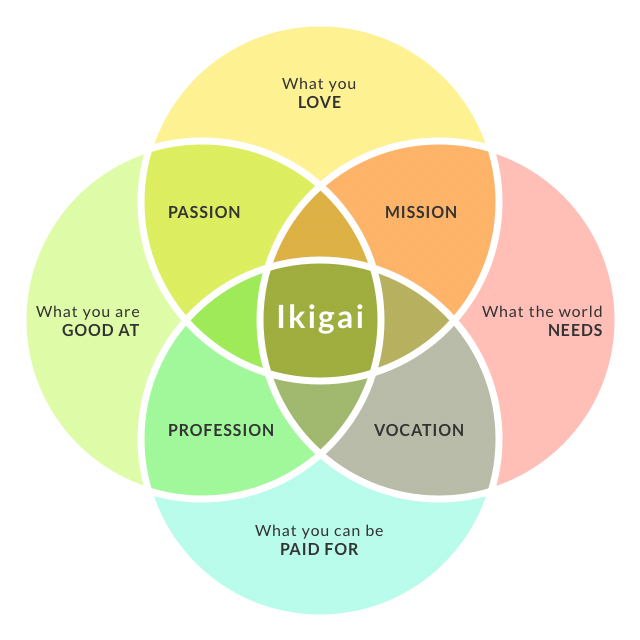
The intersection of all four is your ikigai. The Japanese don't treat this as a personality test or a career quiz. It's a direction of travel — something you move toward across a lifetime, not something you find one Tuesday and then have.
What makes the diagram honest is what it says about partial overlap — the zones where you've got two or three quadrants but not all four:
- Love + good at, but not paid or needed: passion. Delightful, but not a life.
- Good at + paid for, but not loved or needed: profession. Sustainable, but hollow.
- Paid for + needed, but not loved or good at: vocation. Useful, but draining.
- Loved + needed, but not paid or good at: mission. Meaningful, but fragile.
The partial overlaps are not failure states. Most people live there, most of the time. The point is to see clearly which quadrants you have, which you're missing, and whether the gap is costing you something.
The Bullseye Is Rare — That's Fine
Hitting all four simultaneously is unusual. Most careers, especially early ones, involve a trade. You find something you're good at that pays; you hope the love and meaning follow. Sometimes they do. Often the balance shifts across phases of a career or a life.
The insight isn't that you need to find the perfect intersection immediately. It's that optimising hard for one quadrant while ignoring the others creates a specific kind of brittleness. The person who has nailed the career (profession + passion) but let the relationships slide has built something that can't hold. The person who has found purpose and meaning (mission) but whose work isn't sustainable financially is one crisis away from collapse.
You don't need the bullseye to be okay. You do need to be honest about which quadrants you're neglecting — and what that neglect is quietly costing.
The Lifestyle That Holds It Together
The ikigai concept doesn't stop at the diagram. The lessons from Okinawa's centenarians add a set of practices that form the infrastructure underneath the four quadrants — the conditions that make any of it sustainable across a lifetime:
- Stay active, don't retire — find your reason to get up, whatever form it takes
- Take it slow — sustainable pace over performance; the Goldilocks principle in practice
- Don't fill your stomach — Hara hachi bu: stop at 80%, leave capacity in reserve
- Surround yourself with good friends — the Harvard Study of Adult Development ran for 85 years and reached one conclusion: relationships are the predictor of long-term wellbeing. Not wealth, not career. Relationships. (See: Social Fitness)
- Live in the moment — not as a wellness slogan, but as a corrective to the arrival fallacy: the belief that things will finally be right when. They won't. (See: The Arrival Fallacy)
These rules aren't separate advice. They're the conditions under which the four quadrants can actually function. A career you love becomes unsustainable without the pace. A mission falls apart without the community. The diagram lives inside the lifestyle — you can't optimise one and ignore the other.
The Single-Variable Trap
The dominant career advice of the last fifty years — "follow your passion" — treats one quadrant as if it contains all four. It doesn't. See: The Passion Myth.
But the same mistake runs through almost every self-improvement framework. Hustle culture optimises for profession (output, income, status) while discarding pace, relationships, and rest. Purpose-driven work can become the mirror image — mission without money, meaning without sustainability. Relationships-first philosophies sometimes ignore the uncomfortable reality that people who don't have work they're proud of often struggle to invest in relationships at all.
Each of these is a partial truth masquerading as a complete answer. Ikigai's contribution is structural: it names all four variables at once and refuses to let you pretend that getting one right is sufficient.
This connects to what Self-Determination Theory calls the three roots of intrinsic motivation: autonomy, competence, and relatedness. None of these is passion. All three require sustained investment across different domains — you can't get relatedness from your career capital, and you can't get competence from your social life. They require different things from you.
The Adjacent Possible
One thing Ikigai shares with the flow research: the conditions for flourishing are not static. Csikszentmihalyi's insight — that peak experience requires challenge slightly above current skill — applies to the whole framework, not just to individual tasks.
The ikigai bullseye isn't a destination you hit once. It's a moving target that shifts as you develop. What you're good at expands. What the world needs changes. What you can be paid for evolves with markets and context. What you love deepens or shifts as you do.
This means the right question isn't "have I found my ikigai?" It's "am I moving toward better alignment across all four quadrants — and maintaining the conditions that make the whole thing sustainable?"
The Coaching Application
When someone in a 1-1 is quietly dissatisfied but can't quite name why, the ikigai map is often more useful than a direct conversation about happiness or purpose:
- Which quadrants do you have? Most people can identify two or three fairly quickly.
- Which is missing? The missing quadrant is usually where the dissatisfaction lives.
- What's the cost of the current imbalance? This makes the conversation concrete rather than existential.
- What's one thing you could do to move toward the missing quadrant? Small steps, not life redesigns.
The Okinawan framing helps here too — it de-dramatises the conversation. Ikigai isn't a big existential revelation. It's a direction of travel. You don't need to solve it this week.
Related
- The Passion Myth — deep dive on the passion quadrant; why it's downstream, not upstream
- Social Fitness — the relationship evidence base; "surround yourself with good friends" unpacked
- The Arrival Fallacy — why optimising for milestones doesn't deliver what the diagram promises
- Deliberate Practice — How to Actually Get Better — how you build the "what you're good at" quadrant
- Attention as the Primary Resource — attention allocated across quadrants, not just career